Welcome to glum's documentation!
glum is a fast, modern, Python-first GLM estimation library. Generalized linear modeling (GLM) is a core statistical tool that includes many common methods like least-squares regression, Poisson regression and logistic regression as special cases. In addition to fitting basic GLMs, glum supports a wide range of features. These include:
- Built-in cross validation for optimal regularization, efficiently exploiting a “regularization path”
- L1 and elastic net regularization, which produce sparse and easily interpretable solutions
- L2 regularization, including variable matrix-valued (Tikhonov) penalties, which are useful in modeling correlated effects
- Normal, Poisson, logistic, gamma, and Tweedie distributions, plus varied and customizable link functions
- Built-in formula-based model specification using
formulaic - Classical statistical inference for unregularized models using dispersion and standard errors
- Box and linear inequality constraints, sample weights, offsets
- A scikit-learn-like API to fit smoothly into existing workflows
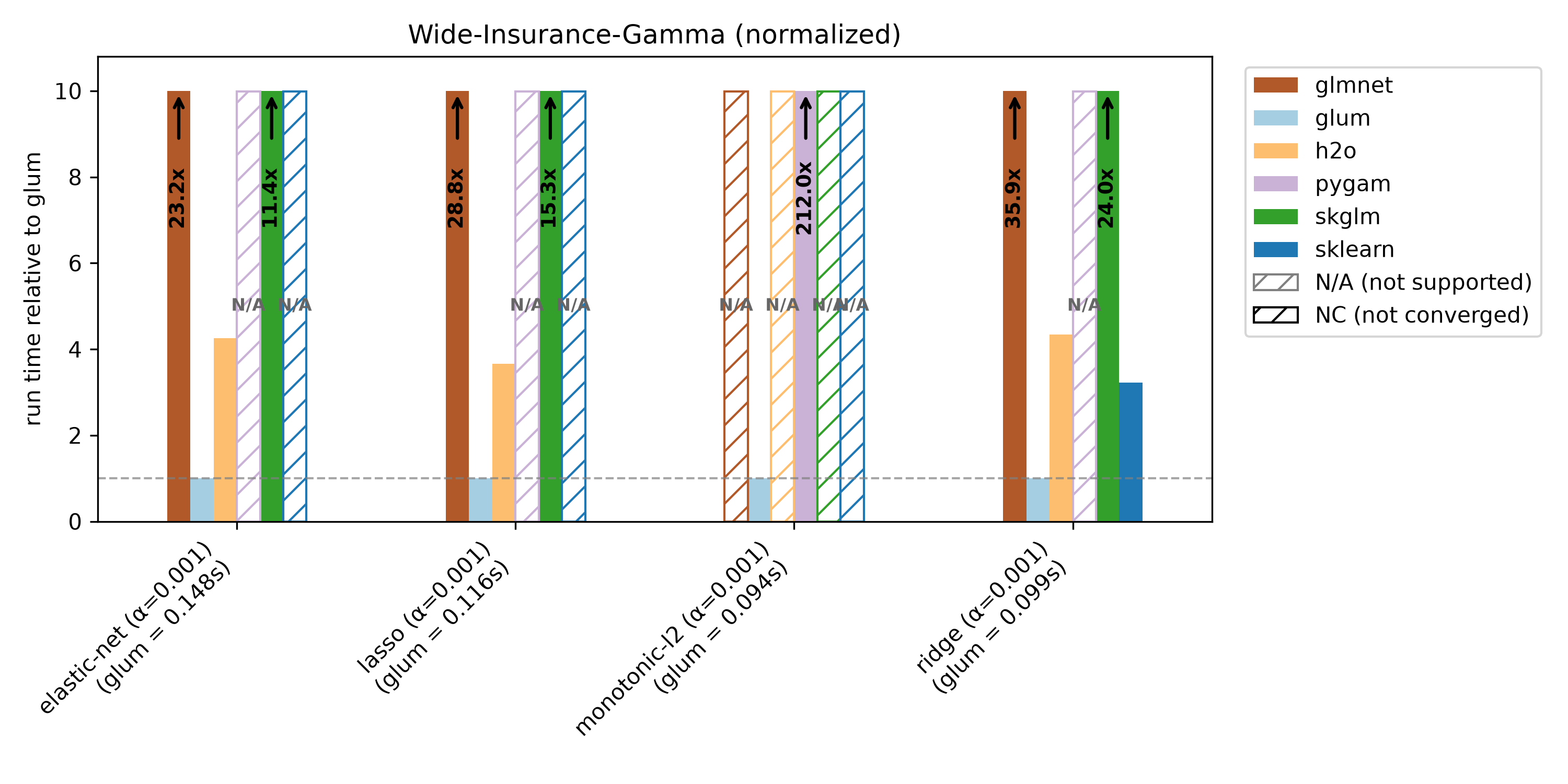
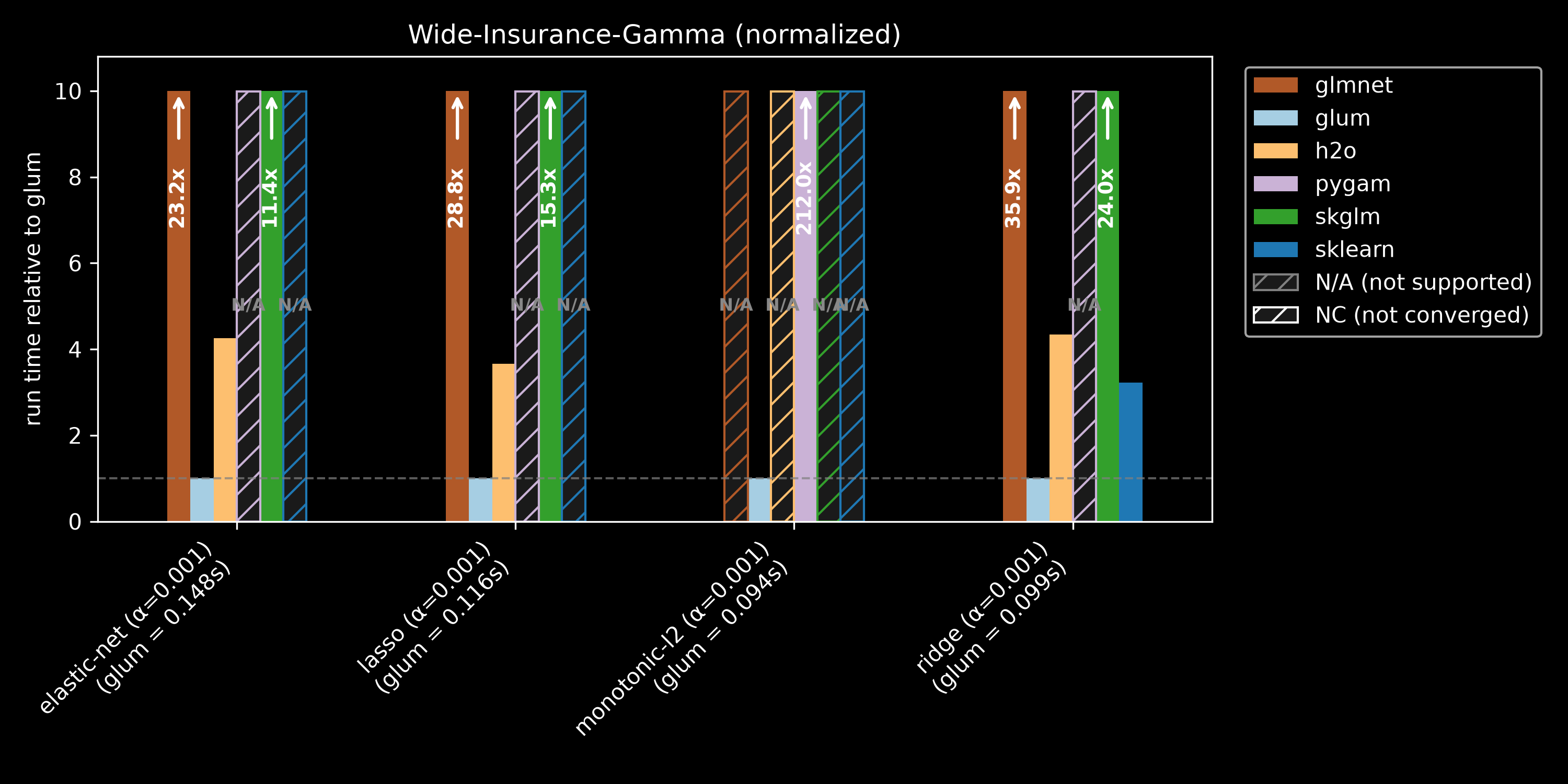
glum was also built with performance in mind. The following figure shows the runtime of a realistic example using an insurance dataset. For more details and other benchmarks, see the Benchmarks section.
We suggest visiting the Installation and Getting Started sections first.